
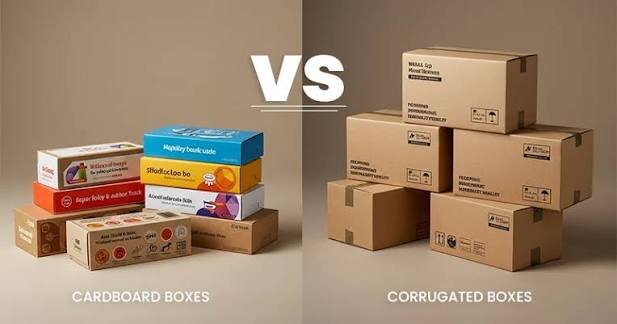
The terms “cardboard” and “corrugated” are sometimes confused when selecting packaging for a product.
Both of them are paper-based packaging materials; their structure, strength, looks, cost, and best uses might be very different. The selection of the appropriate one will depend on the product being packaged, the distance it must cover, and the level of protection it requires. Therefore, which is better, cardboard or corrugated boxes? The solution to the problem will be job-specific.
Cardboard vs Corrugated: The Basic Difference
The easiest way to know the difference is to take a look at the way they are created.
A common example of a cardboard box would be a relatively flat, stiff sheet of paperboard. It is smooth and hard, and is mainly used for packaging products in retail stores like cereal boxes, cosmetic cartons, food cartons, and product boxes. The structure of a corrugated box is more engineered. It is normally composed of flat liner sheets between which is placed a fluted, wavy paper layer. This internal flute provides increased rigidity and crushing resistance to the box. In other words, Cardboard is typically used for presentation and light packaging while Corrugated is used for stronger protection and shipping.
What is a cardboard box?
Paperboard packaging is often referred to generally as cardboard. Generally, it is not a fluted structure, but is constructed of a solid sheet of paper-based material. Cardboard is also used to package items that customers can see straight from the shelf, as it is easy to print and smooth.
Common Uses of Cardboard Boxes
Cardboard packaging is ideal for shipments that don't need to be protected from heavy damage.
Common examples include:
-
Small retail products
-
Apparel packaging
-
Gift boxes
-
Pharmaceutical cartons
-
Lightweight consumer products
Cardboard offers many possibilities for die cutting, folding, printing, and finishing, and is a good choice for good presentation.
What Is a Corrugated Box?
Corrugated packaging consists of several layers of paper, with a fluted layer in the middle. The fluting provides space between the outside liners. This structure aids in resisting compression, impact, stacking, and handling during shipping. Hence, corrugated boxes are popular for e-commerce and shipping options.
Common Uses of Corrugated Boxes
Corrugated packaging can be used for products that require protection during handling and transportation.
Typical applications include:
-
E-commerce shipments
-
Shipping cartons
-
Moving boxes
-
Wholesale packaging
-
Product transportation
-
Subscription boxes
-
Products that are heavy or fragile.
-
Packaging for warehouses and distribution centres
Cardboard and Corrugated Boxes: Key Differences
|
Feature |
Cardboard Boxes |
Corrugated Boxes |
|
Construction |
Usually a solid paperboard sheet |
Flat liners with a fluted middle layer |
|
Strength |
Light to moderate |
Moderate to high |
|
Cushioning |
Limited |
Better impact absorption |
|
Best for |
Retail and lightweight products |
Shipping and transportation |
|
Printing |
Excellent |
Excellent, depending on board and printing method |
|
Appearance |
Smooth and refined |
More structured and rugged |
|
Stacking strength |
Lower |
Higher |
|
Typical use |
Product cartons and retail packaging |
Shipping cartons and e-commerce |
|
Weight |
Generally lightweight |
Lightweight relative to strength |
|
Customization |
Highly customizable |
Highly customizable |
It's important to note corrugated is not just “thicker cardboard.” The fluted structure changes how the material performs.
Which box is stronger?
Corrugated is usually stronger than a paperboard/cardboard box; the box you select will give you greater structural strength in most packaging situations. The fluted layer works as part of the box's structure, helping it handle compression and impacts. Flute profiles and different types of flute boards can also offer varying degrees of protection. For instance, if the product is lighter or less demanding to ship, a lightweight corrugated box for small e-commerce orders may be the right choice, whereas if the product is heavier or more demanding to ship, a stronger multi-wall box may be selected.
Which one is better for Shipping?
Most of the time, corrugated boxes are the better option for shipping. Packaging is not just about carrying weight when it is in the line of shipping. Boxes may be subjected to stacking pressure, drops, vibration, compression, and repeated handling. Such a structure is particularly advantageous in such conditions. Corrugated mailer boxes and shipping boxes can be an option for online businesses to merge protection with branding, too. Businesses can have their logos, colours, messages, etc. directly printed on appropriate packaging.
Which is the Best Retail Packaging Option?
Cardboard/paperboard may be a great option for products that are mostly shelf-stable or stored in another shipping container. The smoothness of its surface ensures a clean printing surface and is ideal for detailed graphic applications, product information, branding, and finishes. Consider a box of chocolates, cosmetics, soap, or cereal. The packaging should be aesthetically pleasing and be sufficient for normal handling. For these situations, paperboard might be a more sensible choice than heavy-duty corrugated packaging.
Cardboard vs Corrugated: Cost Comparison
It is not easy to determine which is cheaper. The final price will be based on the following factors:
Box dimensions
Material thickness
Board construction
Printing
Finishing
Order quantity
Die-cutting
Insertions and other parts
Paperboard can be an economical solution for lightweight retail packaging. Overall, the cost of corrugated may be lower for shipping as it provides the extra structure, which may help to minimise product damage in transit.
Which Material is Better for Custom Printing?
Cardboard Boxes & Corrugated Boxes are both customizable with branding. Paperboard is typically a very smooth surface for detailed retail graphics. Corrugated boxes can also be printed, the actual quality of which will vary based on the board, print methods, and whether an outer print surface or any other construction is used. So, for a brand, the decision should be based on where the box will be used, rather than what it looks like.
Can Cardboard and Corrugated Boxes be Recycled?
Cardboard/paperboard and corrugated are both paper-based packaging products and can be found in the paper or corrugated recycling streams, but it depends on the recycling program locally and the type of packaging construction. Recyclability can be impacted by coatings, laminations, adhesives, food contamination, and more.
What Business Box Do You Need?
It's easier to find the right one if you begin with the product and its path.
|
Your Packaging Need |
Recommended Option |
Why |
|
Lightweight retail product |
Cardboard/Paperboard |
Clean appearance and excellent printability |
|
Cosmetics or personal-care products |
Cardboard/Paperboard |
Strong branding and retail presentation |
|
Soap or small gift products |
Cardboard/Paperboard |
Suitable for attractive custom packaging |
|
E-commerce orders |
Corrugated |
Better protection during delivery |
|
Heavy products |
Corrugated |
Greater structural strength |
|
Fragile products |
Corrugated with suitable inserts |
Better protection and cushioning potential |
|
Shipping cartons |
Corrugated |
Designed for handling and stacking |
|
Premium retail presentation |
Cardboard/Paperboard or premium corrugated |
Depends on product and protection requirements |
|
Products requiring long-distance shipping |
Corrugated |
Better suited to transportation |
Can You Use Cardboard in a Corrugated Shipping Box?
Absolutely. These materials need not compete with each other. One standard form of packaging is to ship in corrugated boxes and then pack in a printed cardboard or paperboard product box. A cosmetics brand may, for instance, insert its branded product into a high-quality printed carton, then wrap the order in a corrugated shipping carton for shipment. This combination separates product presentation from shipping protection.
What About Kraft Boxes?
Kraft can be used in paperboard packaging as well as corrugated packaging. On its own, the term “kraft” usually indicates the type of paper material/process, not necessarily cardboard or corrugated boxes. A kraft paperboard product box and a kraft corrugated shipping box can thus appear to be similar but have vastly different functions. When strength is a concern, inquire about actual board construction with the packaging supplier and not just by the name of “kraft.”
Which Box Thickness You Should Choose?
Do not just opt for thickness because “thicker is better”. Consider: The heavier the product, the stronger the packaging will need to be. Fragility: Glass, ceramics, electronics, and other fragile products may need more robust packaging in the form of corrugated and protective inserts. Shipping Distance: Packaging for products shipped via multiple distribution points should be capable of withstanding multiple handling.
Stacking: Compression strength is more important if boxes are to be stacked for storage or transport.
Presentation: Smooth printing and finishing may be a priority in retail packaging. Once these are known, a packaging supplier can advise on the board construction that is right for the product.
Cardboard or Corrugated: The Simple Answer
Cardboard or paperboard is a good choice for a lightweight, attractive box if the product is displayed or sold directly to customers. When it comes to shipping, stacking, or ecommerce delivery, corrugated is typically the more durable material to use. And if you need both presentation and protection, then you can use both. The purpose is not to get the strongest box that you can. The challenge is to determine the proper level of protection, presentation, and cost for your product.
Final Takeaway
The distinction between cardboard and corrugated boxes is related to construction and uses. For lightweight cardboard-based packaging of products where appearance, printing, folding, and retail presentation are important, cardboard or paperboard is a good option. Corrugated packaging is ideal for shipping, stacking, and e-commerce, and products that require more protection. When ordering custom boxes, take into account the product's weight, fragility, shipping conditions, branding requirements, and budget. Selecting the appropriate package at the start can help to keep your products safe and prevent waste on packaging.